


 Cart
Cart
 sales@molnova.com



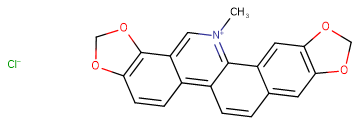
Sanguinarine chloride
CAS No. 5578-73-4
Sanguinarine chloride( —— )
Catalog No. M15029 CAS No. 5578-73-4
Sanguinarine-containing mouthwashes are marketed as anti-plaque and anti-malodor.
Purity : >98% (HPLC)
 COA
Datasheet
HNMR
HPLC
MSDS
Handing Instructions
COA
Datasheet
HNMR
HPLC
MSDS
Handing Instructions
| Size | Price / USD | Stock | Quantity |
| 2MG | 49 | In Stock |


|
| 5MG | 77 | In Stock |
|
| 10MG | 133 | In Stock |
|
| 25MG | 240 | In Stock |
|
| 100MG | Get Quote | In Stock |
|
| 200MG | Get Quote | In Stock |
|
| 500MG | Get Quote | In Stock |
|
| 1G | Get Quote | In Stock |
|
Biological Information
-
Product NameSanguinarine chloride
-
NoteResearch use only, not for human use.
-
Brief DescriptionSanguinarine-containing mouthwashes are marketed as anti-plaque and anti-malodor.
-
DescriptionSanguinarine-containing mouthwashes are marketed as anti-plaque and anti-malodor.(In Vitro):Sanguinarine (SANG)-induced apoptosis is associated with the activation of JNK and NF-κB signal pathways.To determine the effects of Sanguinarine on cell viability, 22B-cFluc cells are stimulated with different concentrations of Sanguinarine for 24 h, and then a CKK-8 assay is performed. The treatment with Sanguinarine decreases the proliferation of 22B cells in a dose-dependent manner. Meanwhile, the cytosolic extracts of 22B-cFluc cells treated with different dose of Sanguinarine are measured to detect cellular caspase-3 activity using Ac-DEVD-pNA, which is a validated caspase-3 substrate. The absorbance at 450 nm increases in a dose-dependent manner, indicating increased caspase-3 activity stimulated by Sanguinarine. (In Vivo):To evaluate the apoptosis induced by Sanguinarine (SANG) in vivo, 22B-cFluc cells are inoculated subcutaneously into one flank of nude mice and xenograft models are allowed to establish. Mice are treated intravenously with 10 mg/kg of Sanguinarine. At 24, 48 and 72 h after treatment, bioluminescent imaging is performed after i.p. injection of mice with 150 mg/kg of D-luciferin substrate. Sanguinarine treatment induces an obvious increase of luminescent signal as early as 48 h after initial treatment. A sustained bioluminescent imaging (BLI) intensity increased is observed throughout the course of experiment. At 72 h after treatment, the tumors are collected and subjected to TUNEL staining for evaluating apoptosis. Compared with the control tumors, the group treated with Sanguinarine exhibits significantly more cell apoptosis, indicated by the increased green signals from the sporadic apoptotic cells.
-
In VitroSanguinarine (SANG)-induced apoptosis is associated with the activation of JNK and NF-κB signal pathways.To determine the effects of Sanguinarine on cell viability, 22B-cFluc cells are stimulated with different concentrations of Sanguinarine for 24 h, and then a CKK-8 assay is performed. The treatment with Sanguinarine decreases the proliferation of 22B cells in a dose-dependent manner. Meanwhile, the cytosolic extracts of 22B-cFluc cells treated with different dose of Sanguinarine are measured to detect cellular caspase-3 activity using Ac-DEVD-pNA, which is a validated caspase-3 substrate. The absorbance at 450 nm increases in a dose-dependent manner, indicating increased caspase-3 activity stimulated by Sanguinarine.
-
In VivoTo evaluate the apoptosis induced by Sanguinarine (SANG) in vivo, 22B-cFluc cells are inoculated subcutaneously into one flank of nude mice and xenograft models are allowed to establish. Mice are treated intravenously with 10 mg/kg of Sanguinarine. At 24, 48 and 72 h after treatment, bioluminescent imaging is performed after i.p. injection of mice with 150 mg/kg of D-luciferin substrate. Sanguinarine treatment induces an obvious increase of luminescent signal as early as 48 h after initial treatment. A sustained bioluminescent imaging (BLI) intensity increased is observed throughout the course of experiment. At 72 h after treatment, the tumors are collected and subjected to TUNEL staining for evaluating apoptosis. Compared with the control tumors, the group treated with Sanguinarine exhibits significantly more cell apoptosis, indicated by the increased green signals from the sporadic apoptotic cells.
-
Synonyms——
-
PathwayAngiogenesis
-
TargetEGFR
-
RecptorEgr-1| VEGFR
-
Research AreaCancer
-
Indication——
Chemical Information
-
CAS Number5578-73-4
-
Formula Weight367.78
-
Molecular FormulaC20H14ClNO4
-
Purity>98% (HPLC)
-
SolubilityDMSO: 10 mM
-
SMILES[Cl-].C[N+]1=C2C3=CC4=C(OCO4)C=C3C=CC2=C2C=CC3=C(OCO3)C2=C1
-
Chemical Name——
Shipping & Storage Information
-
Storage(-20℃)
-
ShippingWith Ice Pack
-
Stability≥ 2 years
Reference
1.Han MH, et al.Toxicol Lett. 2013 Jul 4;220(2):157-66.
molnova catalog



related products
-
BMS-599626
A potent, selective inhibitor of EGFR and HER2 with IC50 of 20 nM and 30 nM.
-
Olmutinib (b)
Olmutinib (HM61713, BI-1482694) is a pontent and T790M-specific third-generation EGFR inhibitor for treatment of NSCLC.
-
Desmethyl Erlotinib
OSI-420 is the active metabolite of Erlotinib (EGFR inhibitor with IC50 of 2 nM).
